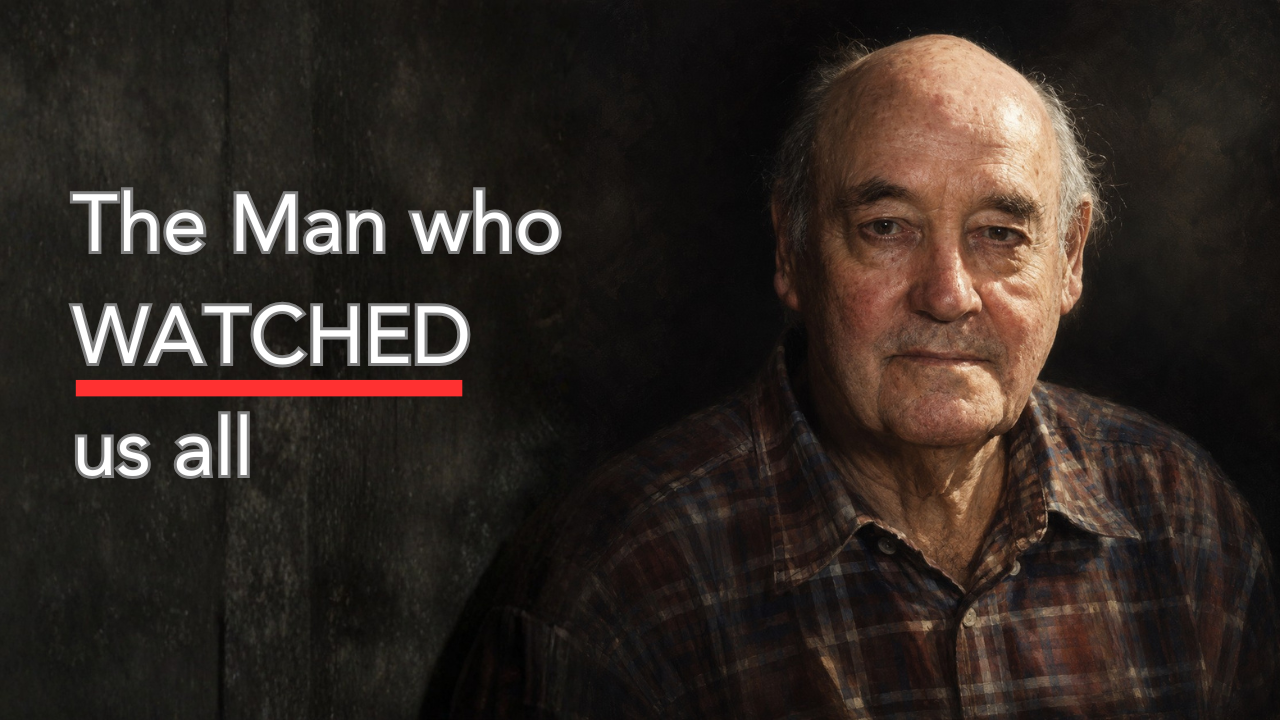
The Man Who Watched Us All
May 13, 2026Desmond Morris (1928 to 2026). Zoologist. Ethologist. Artist. And the guy who noticed things most scientists were too dignified to mention.
He Lived For 98 Years and Barely Stopped.
Desmond Morris died in April 2026, aged 98. He was still painting, still writing, still staying up until 4am because the dark and the quiet were when the work got done. His mother made it to 98 as well. When a young Desmond asked her why she was never ill, she said, "I don't have time, dear." He apparently took that as a life philosophy rather than a punchline.
Born in Wiltshire in 1928, he grew up with a fiction writer for a father and an early obsession with natural history that never really left him. He studied zoology at Birmingham, did his doctorate at Oxford under Nikolaas Tinbergen (Nobel Prize, ethology, look him up), and then, rather than settling into quiet academic obscurity, proceeded to do approximately seven careers simultaneously.
Curator of mammals at London Zoo. Television presenter. Surrealist painter. Author of more than 50 books. Director of the Institute of Contemporary Arts. Broadcaster. A man the Guardian called "an encyclopaedic observer of human behaviour" and the BBC called "legendary." The Artlyst description is probably my favourite: "a rare figure who lived several significant careers in a single lifetime."
In 1966, with four weeks free, he sat down at his father's old typewriter and wrote 80,000 words in 30 days. That was The Naked Ape. His publisher threw the manuscript on a shelf at a Christmas party and read it later. It went on to sell over 10 million copies worldwide.
The Naked Ape and Why It Still Matters
The central argument of The Naked Ape is deceptively simple: we are animals. Specifically, we are a species of primate that developed a very large brain, lost most of its fur, and then spent the next few thousand years pretending otherwise.
Morris applied the tools of ethology, the scientific study of animal behaviour in natural conditions, to humans. He examined how we eat, how we sleep, how we court, how we fight, how we signal status. Not symbolically or philosophically. Biologically. With the same clinical detachment you would bring to studying a troop of baboons.
This was not warmly received in every quarter. Religious groups objected. Some academics found the popularisation too breezy. Morris, characteristically, continued.
The follow-up, The Human Zoo (1969), pushed further. It argued that modern cities function as artificial environments that generate the same stress responses in humans that captive animals develop in small enclosures. Boredom. Aggression. Displacement behaviours. Repetitive rituals with no functional purpose. If that sounds like a description of social media use, it is not a coincidence. Morris was about 50 years early on that one.
Why This Matters to the observational world
My work sits at the intersection of observation, deduction, and human behaviour. That is not a coincidence, and Morris is part of the reason why.
His framework was methodological before it was interpretive. He did not start with a theory about what behaviour meant and then find examples. He started with observation, accumulated evidence, and then drew conclusions cautiously. That is the correct order. It is also, infuriatingly, the opposite of how most "body language experts" operate.
Manwatching (1977), later updated as Peoplewatching, is essentially a field guide to the human species. It catalogues actions, postures, gestures, and facial expressions with zoological precision, examining where they come from and what they actually do. It distinguishes between inborn actions (the ones we did not have to learn), absorbed actions (the ones we picked up without knowing), and trained actions (the ones we were taught). That taxonomy is more useful than most modern frameworks for understanding why people do what they do.
Here is the caveat I will offer honestly, because this we do not trade in mythology: some of Morris's gesture claims, particularly around cultural universality, have not aged perfectly. The science of nonverbal behaviour has moved on. Context matters more than he sometimes allowed. But his foundational approach, that you study behaviour the way you study any other natural phenomenon, with patience, precision, and without wishful thinking, remains correct.
He also had zero patience for vague hand-waving dressed up as insight. He wanted mechanisms. He wanted evidence. He wanted to know why, not just what. That instinct is essentially the entire operating system of Omniscient Insights.
The Dog Books (Because of Course)
I am a dog person. Unashamedly, constitutionally, irreversibly a dog person. So it would be remiss not to mention that Morris applied his same ethological lens to dogs and produced something genuinely useful.
Dogwatching (1986) asks the questions that dog owners actually want answered and that standard dog books chronically ignore. Why does a frightened dog put its tail between its legs? Why do puppies chew things that are not food? Why does a dog bury a bone it has no intention of ever retrieving? Why does a Pointer point?
The answers are not anthropomorphic guesses. They are evolutionary explanations rooted in pack behaviour, wolf ancestry, and survival instinct. All dogs, from the most ragged mongrel to the most insufferably groomed show champion, are members of the same species: the wolf. Morris never lets you forget that, and it reframes everything.
He also wrote Dogs: The Ultimate Guide to Over 1,000 Dog Breeds, which is exactly what it sounds like and does exactly what it promises. Comprehensive. Precise. Exactly the kind of reference work you would expect from a man constitutionally incapable of doing things halfway.
The wider "watching" series, Catwatching, Horsewatching, Animalwatching, Babywatching, follow the same structure: take a species or a demographic, apply the rigour of ethology, and explain what is actually happening rather than what we imagine is happening. They are not academic texts. They are built for people who are genuinely curious and want real answers. That combination is rarer than it should be.
What He Left Behind
He moved to Ireland after his wife Ramona died in 2018. He described her death, in a phrase that stopped me when I first read it, not as bereavement but as amputation. They had worked together for over 60 years. She researched his television programmes and his books. He set up his studio and his library in the new house and kept going.
He opened a visual arts institute in Dún Laoghaire in 2022. He was 94. He continued painting enough new work for an annual exhibition. He died in April 2026, in a hospital in Naas, having outlived almost everyone who had ever argued with him.
The Zoological Society of London called him someone who "recognised that our work had value far beyond academic circles" and who possessed "the rare gift of translating that value for everyone." That gift is underrated. Rigour without communication is a locked room. Morris understood that the point of understanding things is to share what you find.
He was still writing and painting right up until his death. That, more than anything else, is the thing worth taking from a life like his.
Want to go deeper? I did a full episode on Desmond Morris on The Deductionist Podcast. We go into the ethological framework, what it actually means for observation and deduction, and where the science holds and where it needs updating.
Listen to the podcast on the man himself here https://www.omniscient-insights.com/podcasts/the-deductionist-podcast/episodes/2149203952
